




"Curiosity Rover scans
the horizon of Mars!"
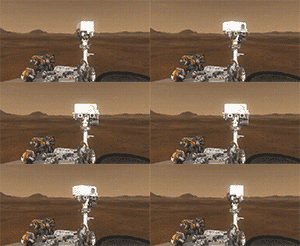
Animation © SkyMarvels.com
derived from NASA/JPL CalTech animation.
Mars, the "Red Planet", is covered with iron oxides ("rust") that give it its distinctive color! (1.6.x) (1.4.1)
Mars, the fourth planet from the Sun, has the second-most eccentric orbit of the eight major planets! (1.6.x) (1.4.1)
Mars possesses two
tiny, irregularly shaped
moons: Phobos (1.6.x) and Deimos (1.6.x). Phobos, the larger of the two, is only about the length of the island
of Manhattan!
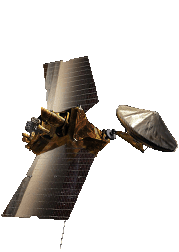
SURFACE VIEWS
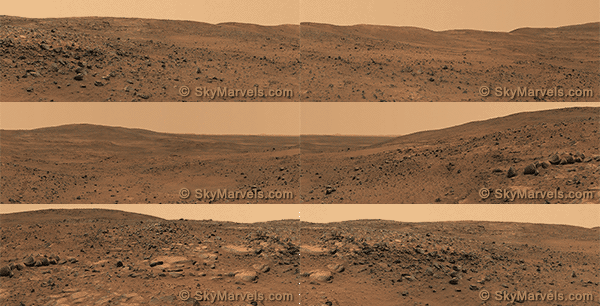
Use NASA's Deep Zoom to scroll and zoom awesome panoramas of the Martian surface!
Then explore the following surface views of Mars that show the diversity in the planet's topography found on various missions. You can go to the NASA page that explains an image by clicking on the tiny page symbol next to the image date.
Spirit Rover:
2004 May 20

2005 Sep 4 - 7
2005 Oct 1 - 3
2005 Nov 3
2005 Nov 23 -28
2005 Dec - 2006 Jan
2006 Feb 9 - 12
2006 Feb 19
2006 Apr 18 - Aug 17
2008 Feb 28 - Jul 2
2008 Feb 28 - Oct 23
2009 May 14 - Jun 20
Lots More
Phoenix Lander:
2008 May - Jun
2008 May - Jun
Opportunity Rover:
2006 Feb 26
2006 Aug 6 - Aug 9
2006 Sep 28 - 29
2006 Oct 16 - Nov 7
2007 Oct 23 - Dec 11
2008 Nov 21 - 24
2010 Nov 10
2010 Dec 16
2010 Dec 18 - 19
2011 Aug 6
2012 Jan
2011 Dec - 2012 May
Lots More
Curiosity Rover:
2012 Oct 5 - Nov 16
2012 Aug 9
2012 Aug 18
2012 Sep 20
2012 Nov
2013 Jun 1
2013 Jul 24
2014 Jan 28
2014 Jan 30
2014 Feb 9
Lots More
Also have a look at NASA's Billion-Pixel View From Curiosity at Rocknest
MARS TRAVERSE MAPS
These maps show the routes taken by four intrepid Martian rovers: Spirit, Opportunity, Curiosity and Perseverance. And Tianwen-1's maps will be added as soon as China pub- lishes them. The awesome ongoing progress of human- kind's exploration of the Martian surface continues!
Spirit
Opportunity
Curiosity Perseverance
Here's a cool NASA graphic comparing the Distances Traveled by Mars and Moon Rovers
as of 2019 Feb. Opportunity rules!
MARS WALLPAPERS
Enjoy these high-resolution images.
MARS ACTIVITIES
MAKE PAPER MODELS OF MARS, ITS MOONS AND SPACECRAFT
MARS: Hi-Res Med-Res
Phobos Deimos Very cool!
SPACECRAFT:
Mars Express Orion
Mars Odyssey
Pathfinder
And more from Canon:
Curiosity Rover
Exploration Rover
Mars Diorama
And here are collections of 3D paper models from simple to advanced! #1 #2 #3
MAKE A PAPER MARS HELICOPTER
Here's a cool activity that you can do on your own or with friends. NASA and JPL show you how to Make a Paper Mars Helicopter!
SIMULATE LANDING
A SPACECRAFT "ON TARGET"
Do you think it's easy to to Land a Spacecraft on Tar- get? NASA & JPL show you how to experience the frustrations AND TRIUMPHS of successful missions.
MAKE A CARDBOARD ROVER
You'll have loads of fun and gain lots of insight with this one! NASA & JPL show you how to Make a Cardboard Rover! Try it on all sorts of different terrain!
Lots More Mars
Activities Here!
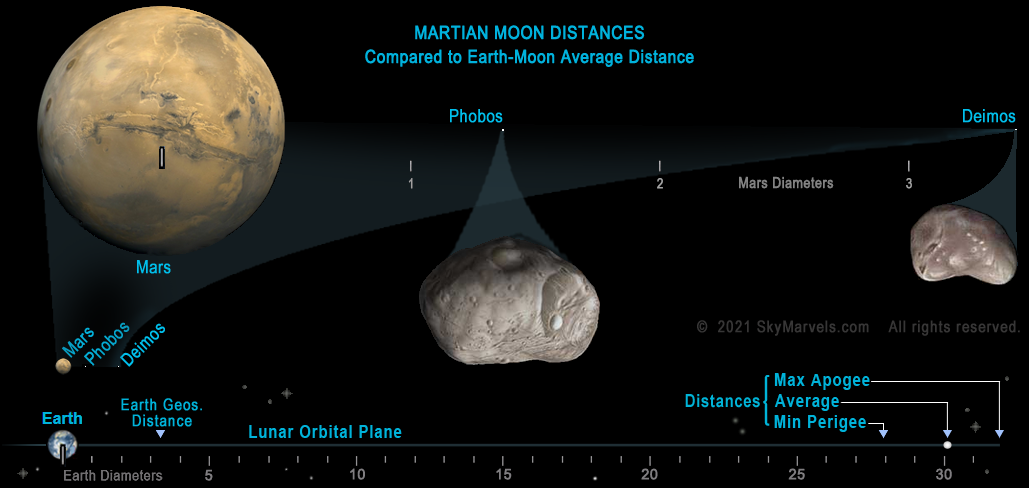
Click on the enlarged images of Phobos and Deimos in the diagram above to view the ir- regular Martian moons in 3-D.
The two Martian moons orbit very close to Mars's equatorial plane and in nearly circular orbits!
ELEMENTS OF THE MARTIAN MOON ORBITS
| Period (Earth Days) |
Orbital Inclin- ation |
Radius (103 km) |
Eccen- tricity |
|
|---|---|---|---|---|
| Pho | 0.319 | 1.08° | 9.378 | 0.0151 |
| Dei | 1.262 | 1.79° | 23.459 | 0.0005 |
The Martian moons may be captured asteroids!
FUTURE OF PHOBOS
Phobos orbits less than one planet diameter from the surface of Mars! It is slowly spiraling down and—likely within 10 million years—will be torn apart inside Roche's limit, forming rings around the Red Planet! Some debris will probably crash into Mars!
Amateur astronomers
find the Martian moons difficult to view. At least
a six-inch telescope is required, and clear
skies are a must.
SKYMARVELS POSTERS FEATURING MARS
SKYMARVELS VIDEOS FEATURING MARS
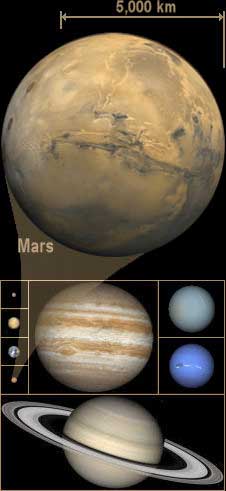
Like Mars itself, its moon system is relatively small.
The diameter of Deimos's orbit is smaller than the diameter of Neptune! So Mars and its system of moons would fit inside
any of the Gas Giants!

In fact, the orbits of Phobos and Deimos
are significantly smaller than the orbits of Earth's geostationary satellites!
CELES-TIPS
The following will help you enjoy this page's 1.6.x and 1.4.1 links that run events directly in CELESTIA. If you're new to the program, these tips will also help you learn to use it.
Are you unfamiliar with our 1.6.x and 1.4.1 links? For an explanation click here.
You'll find more information about many of CELESTIA's controls on our Learning Center page.

"The moons of Mars are tiny, potato-shaped affairs!"
MARS
View Mars in 3-D Another Another 3-D in Orbit
Mars Trek: for 3-D, at Trek window lower left select globe
symbol (Projections), then "3D Globe". At top right
click on "Fly To", enter a Mars location or a Lat & Lon.
Current Views and Conditions from Earth
Current Location in the Constel. Skypath 2024
Current Location in Orbit
Physical Properties:
Equatorial Size: Compare in 3-D
Radius: 3,396.2 km
Diameter: 6,732.4 km
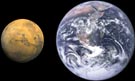
Diameter (Earth = 1): 0.532
Rotational Flattening: 0.00648
Mass (Earth = 1): 0.107
Volume (Earth = 1): 0.151
Mean Density (Water = 1): 3.94
Mean Density (Earth = 1): 0.713
Surface Gravity (Earth = 1): 0.379
Surface Temperatures: average -63°C (-81°F) 
Axial Tilt: 25.19°
Where Poles Point
Rotation Period:
Synodic ("Day" in Earth hours): 24.6597
Sidereal (in Earth hours): 24.6229
Note: Earth Day Lengths
Mean Solar: 24.0000 hours (24h00m00s)
Sidereal: 23.9345 hr (23h56m4.1s)
Albedo (geometric): 0.17
Magnetic Field (Earth = 1): 0.02 NASA Graphic
NASA's Overview of Mars (3-D)
NASA's Moon to Mars
NASA's Mars Exploration Program
NASA's Mars Facts Poster

COMPARE MARS TO EARTH'S CONTINENTS
Mars Surface:
Hi-res Globes: #1
VIKING Mission
Annotated Partial Global Map (7.25 km per pixel)
Download High-Res Maps:
2k
4k: #1
#2
6k: #1
#2
8k
Bump Maps
Explore Mars! from ESRI
Landing Sites
Mars-scapes in 3-D:
Olympus Mons
Gale Crater
Victoria Crater
Murray Buttes 1
Murray Buttes 2
Perseverance Valley
Naukluft Plateau
Troy
ExoMars Landing Site?
Cape Tribulation
Discovering Gale Crater 3-D from the LA Times
 Polar Caps
. . . . . . . . . . . . . . . .
Polar Caps
. . . . . . . . . . . . . . . .
And don't forget Mars Trek
Mars Weather:
The Red Planet "Dashboard"
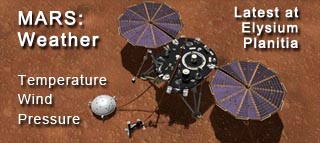
InSight at Elysium Planitia
Curiosity at Gale Crater
Mars Perseverance at Jezero Crater
MRO 2007-2019: Global Weather MRO Archives
Mars Atmosphere: very thin
Surface Pressure (Earth = 1): 0.006
NASA Mars Facts Sheet
Wikipedia page
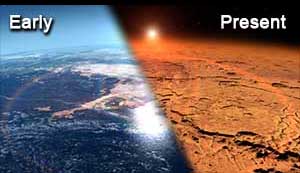
Loss Over Time
Current:
Compared to Earth's Atmosphere
Carbon Exchange and Loss Processes
Terraforming
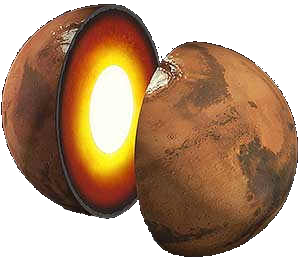
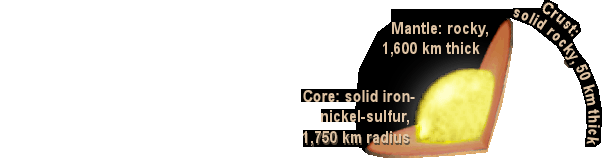
Mars Structure:
NASA/JPL:

Hi-res 3D Mars Exploded View
Compared to Other Inner Planets
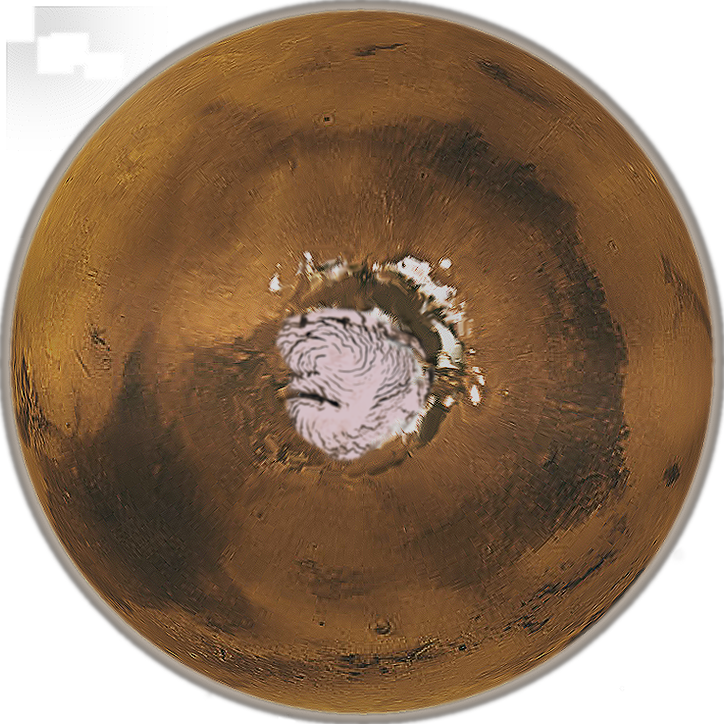
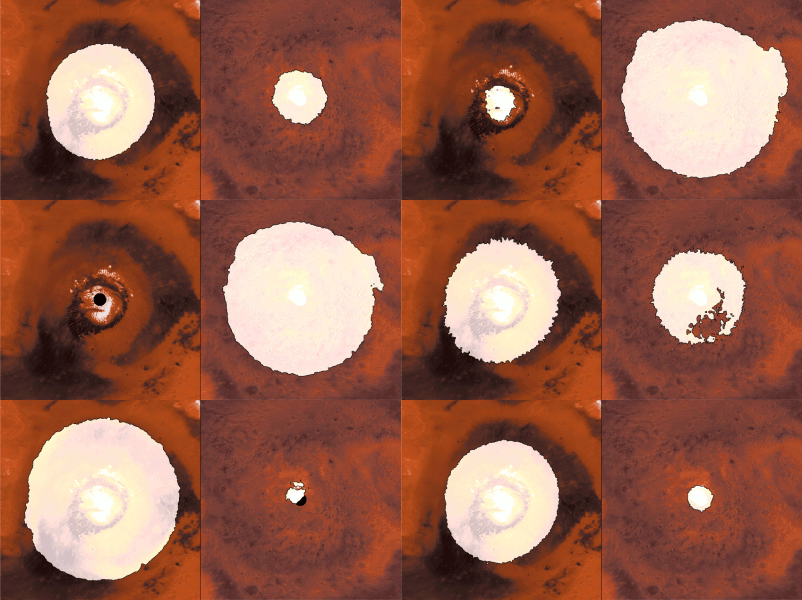
MARS FROM ABOVE ITS NORTH POLE
(at its Equinoxes)
Spacecraft in 3-D:
Curiosity: #1 #2 #3 #4 #5 Drive
Spirit & Opportunity: #1 
InSight: #1 #2 #3 Experience
Mars Odyssey: #1
Mars Maven: #1
ESA 2020 ExoMars Rover
Mars Reconnaissance Orbiter: #1 #2
Mars 2020 Perseverance Rover: #1 #2 #3
Mars 2020 Ingenuity Helicopter
Mars Launch Windows
It's a miss!

It's a hit!

Mars Classifications:
Inner Planet (along with Mercury, Venus & Earth)
Terrestrial Planet (primarily Earth-like structure)
Superior Planet (has larger orbit than Earth)
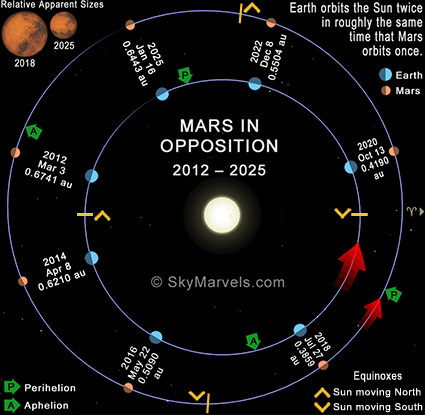
Mars Orbit: Current
(1.6.x)
(1.4.1)
Sidereal Period: 686.980 Earth solar* days
Tropical Period: 686.973 Earth solar* days
Distance from Sun:
Mean (Earth = 1 AU): 1.524 AU
Mean: 227,920,000 km
Perihelion: 206,620,000 km (1.381 AU)
Aphelion: 249,230,000 km (1.666 AU)
Velocity:
Mean: 86,868 km/hr
Min: 79,092 km/hr
Max: 95,400 km/hr
Eccentricity: 0.0935
 Inclination to Ecliptic: 1.85°
Retrograde Motion:
General
NASA's Mars in Our Night Sky
Ring System: None
Mars Moons: 2 - Phobos ("fear") & Deimos ("dread")
Find Current Positions with NASA/JPL Orrery
Opens showing Mars. Scroll out with mouse-
wheel to see Phobos and Deimos in orbit.
Find Current Positions with Mars Moon Tracker
Compare Phobos and Deimos to Mars
Compare to Other Moons
Cool Paper Models: Phobos Deimos
NASA's Moons of Mars page
Wikipedia's Moons of Mars page
Moons in 3-d: Phobos Deimos
Maps: Phobos w/Labels Deimos
Size in Martian Sky Compared to Moon in our Sky

Mars and its moons' orbits are
tilted relative to the Ecliptic!
Phobos's and Deimos's Orbits & Motions:
Orbits nearly circular.
Orbits nearly equatorial.
Phobos:
Distance Above Martian Surface: 5,980 km
(this is less than 1 Mars diameter!)
Orbital Radius: 9,376 km
Orbital Eccentricity: 0.0151
Orbital Inclination to Mars Equator: 1.08°
Orbital Period: 7.66 hrs
Rotation Period: 7.66 hrs (synchronous)
Apparent Motion: (from Martian surface)
Rises in west; sets in east (retrograde)
Visible 5½ hrs, below horizon 5½ hrs
Orbits 3 times a day.
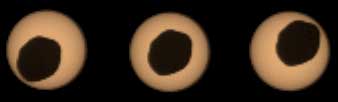
Phobos Transit (Eclipse) of the Sun
recorded by Curiosity 2013 Aug 29
Deimos:
Distance Above Martian Surface: 20,063 km
Orbital Radius: 23,459 km
Orbital Eccentricity: 0.0005
Orbital Inclination to Mars Equator: 1.79°
Orbital Period: 30.35 hrs
Rotation Period: 30.35 hrs (synchronous)
Apparent Motion: (from Martian surface)
Rises in east; sets in west (prograde)
Visible 33 hrs, below horizon 33 hours.
Orbits less than once a day.
2019 Eclipses Captured by Curiosity

Curiosity sees Phobos pass Deimos in Martian sky on 2013 Aug 1
NASA's Mars Printable Visual Fact Sheet
Image Tours: Mars 2005 from HubbleSite
Timekeeping on Mars
Partial Information Source: NASA Fact Sheets
ADJECTIVES MEANING
"pertaining to Mars"
Martian
Arean (from Greek god, Ares)
View NASA's awesome Mars Exploration site.
MARS ATMOSPHERE LOSS
video credit: NASA/Goddard Space Flight Center
LANDING SITES OF NASA MISSIONS
video credit: NASA/Goddard Space Flight Center
MARS SCIENCE LABORATORY
Curiosity ROVER
video credit: NASA JPL CalTech
Curiosity ROVER'S FIRST TOUCH AND GO
video credit: NASA JPL CalTech
EXPLORE MARS WITH Curiosity
video credit: NASA JPL-CalTech
DIRECT LINKS TO OTHER NASA VIDEOS
You must have the noted player installed to view these. Note: you might have to click on these more than once, as some NASA servers (like http://svs.gsfc.nasa.gov in particular) can be temperamental and slow to connect. If a video does not load, try again at another time.
From NASA's Photojournal pages, here's Curiosity Speaks
From NASA's Photojournal pages, here's Great Convergence of Spacecraft around Mars
LINKS TO SOME VERY COOL NASA-JPL
MARS DOWNLOADS AND MORE
Want to know what time it is on Mars? And what parts of Mars are in daylight and darkness? Go to NASA's Mars24 Sunclock page and download their app. Available for Windows, Mac and Linux.
Mars Science Laboratory (Curiosity) Launch Press Kit (PDF, 5.21 MB) Lots of pictures and background info!
Beautiful Earth/Mars Comparison Poster (PDF, 298 KB) Perfect for any classroom or dorm room!
2013 - 2014 One Mars Year / Two Earth Years Calendar> (PDF, 7.2 MB) Your own "dual-planet" calendar!
Timeline of Mars Exploration Missions. Lots of good background info here!
Home Intro News Gallery Sky-Gifts Bonuses Tips
Learning Ctr Help Links Credits Legal Contact Us
© 2007-
by Gary M. Winter. All rights reserved.
Interested in political cartoons and humor?
Check out The HIPPLOMATS™.
SkyMarvels, Sky Marvels, SkyMarvels.com, celestia4all, celestiaforall, CELESTIA, astronomy, space, simulations, animations, downloadable astronomy posters, stars, planets, Inner Planets, Outer Planets, Inferior Planets, Superior Planets, moons, asteroids, comets, Oort Cloud, galaxy, galaxies, Milky Way, Andromeda, globular clusters, binaries, quasars, black holes, supermassive black holes, telescope, telescopes, planetarium, software, freestuff, satellites, add-ons, addons, scripts, eclipses, Solar Eclipses, Lunar Eclipses, Solar Eclipse Finder, Lunar Eclipse Finder, mutual eclipses, transits, occultations, Solar System, CELES-TOOLS, celeSTARrium, CELX, CELX programming, Freebies, Bonuses, multiple views, atronomical unit, light year, parsec, meteors, meteor showers, Perseids, Geminids, Leonids, barycenter, time, Time Zones, tides, alignments, conjunctions, oppositions, seasons, apogees, perigees, aphelion, perihelion, Earth, Luna, Mercury, Venus, Mars, Jupiter, Galilean Moons, Io, Europa, Ganymede, Callisto, Saturn, Titan, rings, Uranus, Neptune, Triton, E-MSpectrum, electromagnetic spectrum, astronaut, equinoxes, solstices, precession, rotation, spin, inclination, tilt, Ecliptic, orbits, ellipse, parabola, hyperbola
Donate safely with: PayPal
and receive one or more
Sky-Gifts. Your support is greatly appreciated!
NOTE: you do not need a PayPal account to donate.
SKY VIEWING
SOLAR SYSTEM
THE SUN
MERCURY
VENUS
EARTH
THE MOON
MARS
JUPITER
SATURN
URANUS
NEPTUNE
SMALLER WORLDS
STELLAR OBJECTS
EXOPLANETS
DEEP-SKY OBJECTS
SCALE OF THE COSMOS
———————
SKY-FUN / SKY-GAMES
NASA's LATEST
MARS 2020 Mission: Perse- verance Rover
ESA's LATEST
MARS FUN FACTS
The surface area of
Mars roughly equals the
land area of Earth!
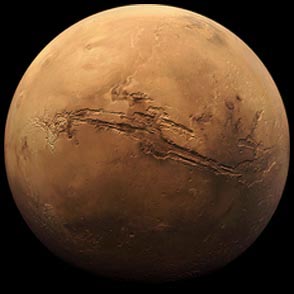
A world of superlatives, Mars can claim both the tallest mountain (Olympus Mons) and deepest valley (Valles Marineris)
on the major planets of the Solar System!
Likewise, there is compelling evidence that Mars once had a waterfall over 4 km (2½ mi) high—the highest waterfall in the Solar System! Yes, Mars is now thought to have once been a "blue planet" much like current Earth, with vast areas covered by water!
Long ago, Mars lost of its magnetic field, triggering the loss of most of its water!
Mars's Southern Hemisphere is mostly volcanic highlands; Mars's Northern Hemisphere is principally non-volcanic lowlands!
Mars has a month named after it—March!
The atmosphere of Mars is 95% carbon dioxide, the gas that bubbles up when you shake many soft drinks!
Because the Martian atmos- phere is so thin, there is almost no wind chill on Mars!
Phobos orbits less than one planet diameter from Mars's surface! It is slowly spiraling down toward Mars and may be torn apart to form rings within 10 million years!
Because it is much closer than Earth to the Asteroid Belt, Mars is struck more than 200 times each year by asteroid fragments one to two meters in diameter!
Scientists believe that, here on Earth, they have found pieces of Mars blasted from the red planet by meteoroid impacts!
MARS INTERACTIVES
QUICK ACCESS LIST
Note: some links are echoed elsewhere on this page and may include descriptive text.
Explore InSight an awesome NY Times page!
NASA's Mars Trek: for 3-D globe, at lower left of Trek window select globe symbol (Projections), then 3D Globe.
Jezero Crater Explorer Tool from ESA
Explore with Perseverance sites where rover has visited!
Links to interactive features that show Mars's orbit in 3-D can be found on our Solar System page
Experience Curiosity: is a 3-D driving adventure on Mars!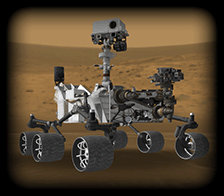
Here is a cool experience in JPG format: Curiosity: Seven Minutes of Terror!
Future Mars Habitats in 3-D: #1 #2 #3 #4 #5 #6
From ESRI, here's the awesome Explore Mars! application!
Here's the New York Times link to its awesome: Mars Curiosity Rover Tracker.
Mars Viewer allows you to find the tilt of Mars & its hypothetical rings, and the locations of its moons, for any time and date.
Mars Moon Tracker allows you to generate and download diagrams of the locations of Mars's moons over spans of time.
MARS'S EQUINOXES
As each planet moves through the Solar System, twice during each orbit its equatorial plane aligns with the Sun. From a planet's own perspective, this is when the Sun moves across its celestial equator in its sky, and the planet's Northern and Southern Hemispheres are il-luminated equally.
Due to Mars's orbital eccen- tricity and the locations of its equinoxes relative to its peri- helion and aphelion, Martian equinoxes are separated by about 12½ Earth-months and then 10 Earth-months, in a repeating cycle which has consequences for Martian seasons . Nearly twice as long as Earth seasons, they are only roughly so, and they are considerably more vari- able in length. Moreover, as the planet's Southern Hemi- sphere "leans toward" the Sun when Mars is nearer perihelion than aphelion, its summer is notably warmer than summer in the Martian Northern Hemisphere!